Whitesville 2-Pack T-Shirt Review: Are These "Loopwheel" Tees Worth the Price?
Made with circular-knitting machines in Japan using long-staple cotton, there's more to the fabric than meets the eye

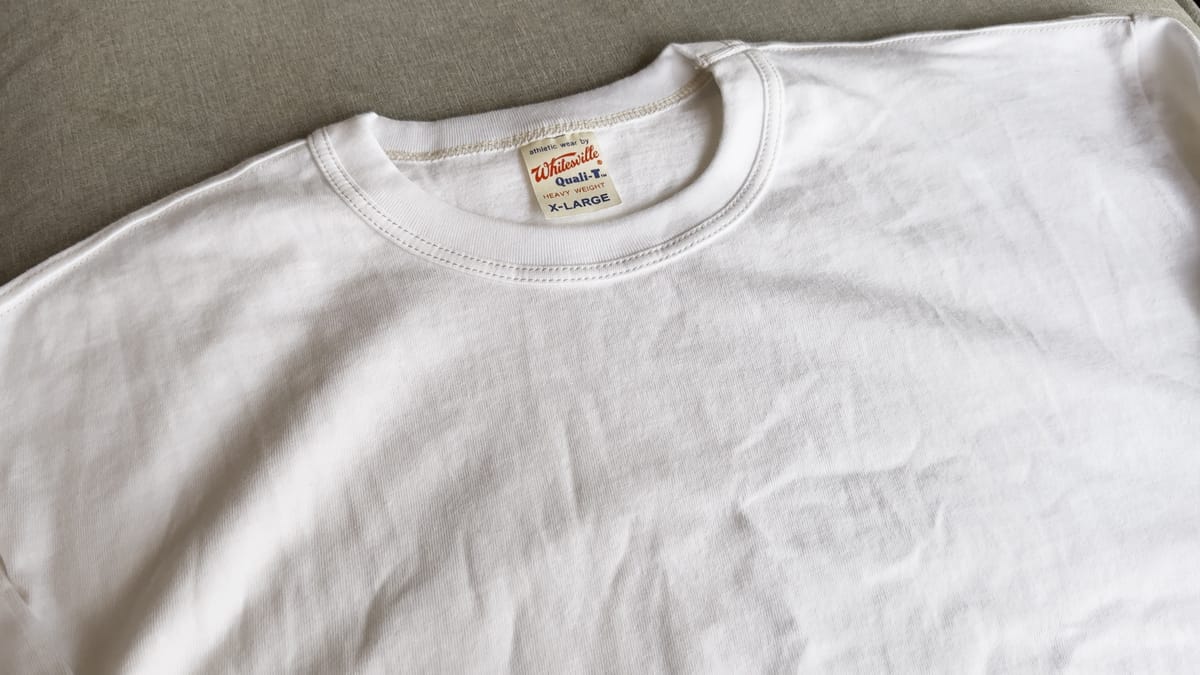
Of all the garments in my wardrobe, t-shirts are the thing I would historically spend the least money on.
For most of my life, I barely gave t-shirts a second thought when it came down to buying more variety in clothing — I always felt like spending the money on literally anything else was worth more than putting it toward a simple, plain tee.
Maybe it's due to the fact that tees tend to get worn through the quickest out of anything I wear; so the idea that a "temporary" tee having the courtesy of more of my money seemed like a strange move to make.
If I needed a basic tee, I'd usually grab something 100% cotton from Uniqlo, pick up Hanes Beefy-Tees, or buy whatever happened to be convenient and reasonably priced online at the time (or in a physical Navy Exchange, Base Exchange or regular store like Costco or Walmart).
To me, a t-shirt is just a t-shirt — that's what I kept telling myself, anyway.
My perspective was never "quality tees aren't worth it," because I come from the raw denim world where brands like Iron Heart exist. I fully understood the idea of a quality tee, I could just never bring myself to pull the trigger on one. Until now.
Many of the differences between a decent t-shirt and a great t-shirt aren't obvious when you're just looking at a folded shirt on a shelf at a distance. Of course not. You have to look a little closer to see the real qualities.
Few plain tees illustrate this concept of quality better than the Japanese-made Whitesville shirts, which always come in a 2-pack.
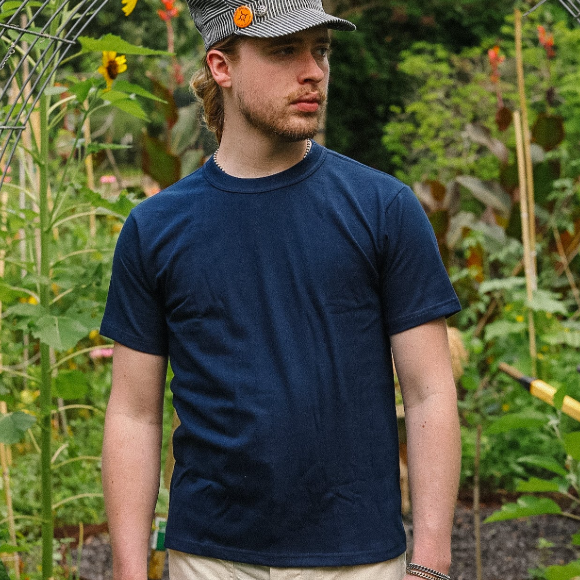

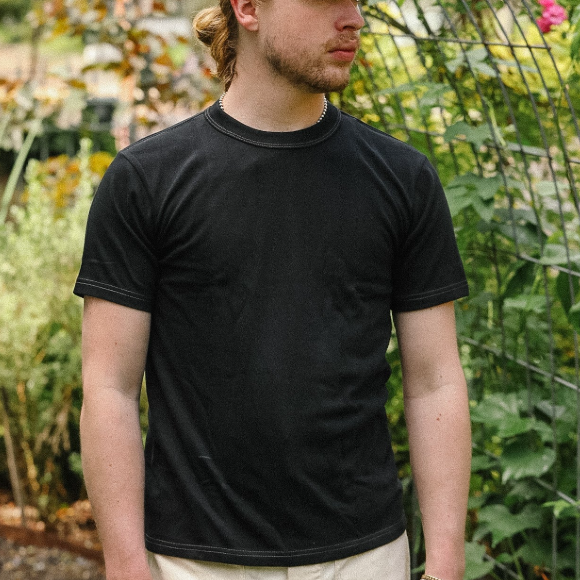
Even the Whitesville colored variants come in 2-packs. Photo Credit: Iron Shop Provisions
> JPfans is a proxy service that ships marketplace items and Amazon.jp products direct from Japan.
The History of Whitesville
Toyo Enterprise, a name enthusiasts of Americana and reproduction clothing might recognize, is a company hailing out of Japan — Whitesville being one of its heritage-inspired labels, a name they bought for licensing rights in 2007.


Toyo Enterprise itself holds the names Buzz Rickson's, Sugar Cane, Sun Surf, and Tailor Toyo — brands renowned for painstakingly accurate reproductions of vintage American military clothing, workwear, Hawaiian shirts, and souvenir jackets. Their reputation within the heritage space has been built on obsessive attention to detail and historically-accurate manufacturing processes.
The Whitesville name itself traces its inspiration back to classic American athletic/sportswear and casual clothing from the 1950s. The brand specialized in the sort of garments many Americans once considered completely ordinary: sweatshirts, varsity-inspired apparel, and perhaps most famously, plain loopwheel-inspired tees.
Are Whitesville tees actually loopwheeled?
Regardless of the exact knitting machinery involved, the verdict remains unchanged:
Whitesville delivers the authentic, low-tension, beautifully raw, side-seam-free experience that defines true heritage knitwear.
Tsuri-ami (吊り編み) means "hanging knitting" in Japan and is used when talking about the vintage loopwheel machines most enthusiasts are familiar with.
With traditional tsuri-ami machines, the fabric hangs under its own weight rather than being continuously pulled downward by an active take-up mechanism, resulting in much lower knitting tension.
This term is specific to vintage loopwheel knitting machines, the kind most western consumers would think of when the term loopwheeled is used.
What many people don't realize is that other vintage circular knitting machines can also produce exceptionally low-tension, tubular jersey with many of the same qualities enthusiasts associate with loopwheel fabrics.
So despite the Amazon.co.jp listing stating,
"Whitesville 2-Pack T-shirts Men's Plain Short Sleeve Loopwheeled Tees by Toyo Enterprises WV73544"
This is better understood as a translation and marketing simplification than a description of the specific machinery. The shirts deliver the characteristics most buyers associate with "loopwheeled" construction — low-tension knitting, tubular construction, and a vintage feel; even if the underlying knitting technology differs from traditional tsuri-ami machines.
The Three Tiers of Tubular T-Shirt Tech
| Feature | Tier 1: Traditional Loopwheel (Tsuriami) | Tier 2: Vintage Circular Knitting | Tier 3: Modern High-Speed Circular |
|---|---|---|---|
| Examples | Merz b. Schwanen, Loopwheeler | Whitesville, Warehouse & Co., The Flat Head | Hanes Beefy-T, Pro Club, Gildan |
| Speed / Output | Extremely slow (~1 m/hr) | Low to moderate speed | Very high speed |
| Tension System | Gravity-assisted, minimal take-up tension | Mechanical take-up, low tension | High-speed mechanical take-up |
| Fabric Character | Lofty, airy, subtly irregular | Soft, dense, resilient | Uniform, firm, can be prone to twisting after washing |
At a technical level, vintage Japanese circular knitting machines can preserve many of the low-tension, lofty fabric qualities associated with traditional loopwheel machines while offering significantly greater production efficiency.
Conversely, most modern circular knitting machines used for mass-market production prioritize high-speed manufacturing and high-volume output over the low-tension approach favored by heritage knitting.
Japan has been using imported German loopwheel machines (tsuri-ami-ki) for decades, and a small number remain in operation today. If you're specifically looking for Toyo's true loopwheel offerings, you'll more commonly find them under premium labels such as Buzz Rickson's.


Search for Buzz Rickson's on Redcast Heritage (earns commissions)
Why are Whitesville t-shirts popular?
At a glance, and if you're anything like me when it comes to tees: the Whitesville 2-pack doesn't seem particularly exciting:
- It's two plain t-shirts in a bag
That's it. No logos. No graphics. No flashy branding.
But that's a huge part of the appeal in the first place.
These shirts have become something of a cult favorite among denim enthusiasts, heritage styles, streetwear fans, and people who simply appreciate well-made basics.
The first reason? The fabric
Whitesville uses long-staple cotton yarns, likely from the United States and Australia, which produce a smoother, stronger and softer fabric compared to the shorter fibers commonly found in inexpensive basic tees.
Longer fibers mean fewer loose ends and micro frays protruding from the yarn, resulting in a cleaner appearance and slightly improved durability over time. The hand will feel better (smoother), and the longer fibers make the overall appearance less grainy, allowing you to see the knitted weave more clearly.
The shirts are also knitted in a tubular construction, but more specifically using vintage knitting machines (invented circa. 1950-60s), producing a 7oz mid-weight material before being washed.
Unlike many modern t-shirts that assemble the front and back panels by joining them with side seams, tubular shirts are knitted as a continuous tube. This eliminates side seams entirely, creating a cleaner silhouette and reducing the possibility of twisting or distortion as the garment ages (unless it's a mass-market tubular-knit, where higher tension can result in body twist).
Loopwheel tees are always tubular, but not all tubular knits come from loopwheel machines. As an example again: the Hanes shirt is tubular, but not loopwheeled.
For anyone accustomed to mall brand t-shirts that start spiraling after a few wash cycles, the difference in the experience can be significant.
Speaking of washing, these Whitesville t-shirts are raw cotton — so they're unwashed, and why I tend to mention denimheads when talking about loopwheel tees. Not all loopwheel tees are raw, but neither is all denim. It's more about the product the company is trying to sell, ultimately, as many of them wash their t-shirt offerings to help prevent shrinkage after sale.
(And yes, at this point I understand I'm referring to the Whitesville as loopwheel — the low-tension circular knit machine produces something similar, or at least on its way there).
More on measurements and washing/shrink behavior in its own section below.
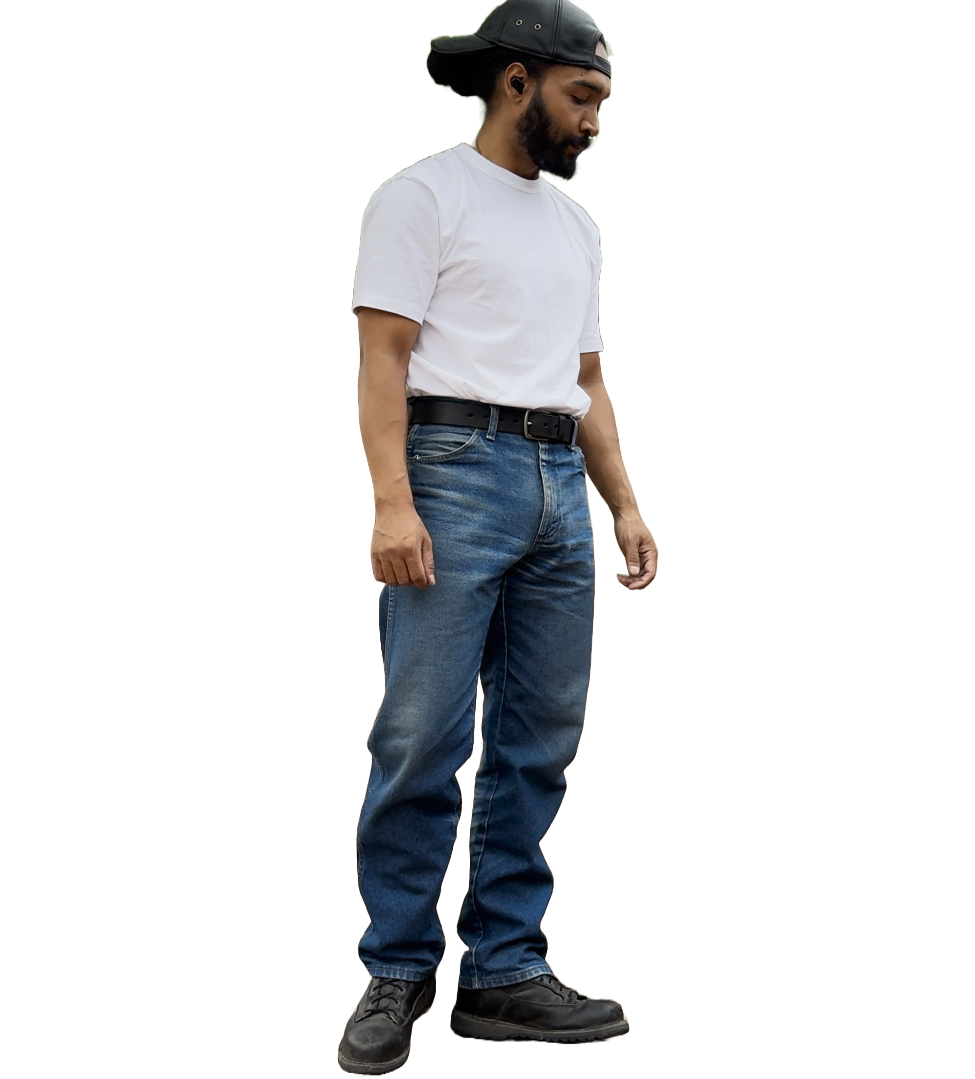
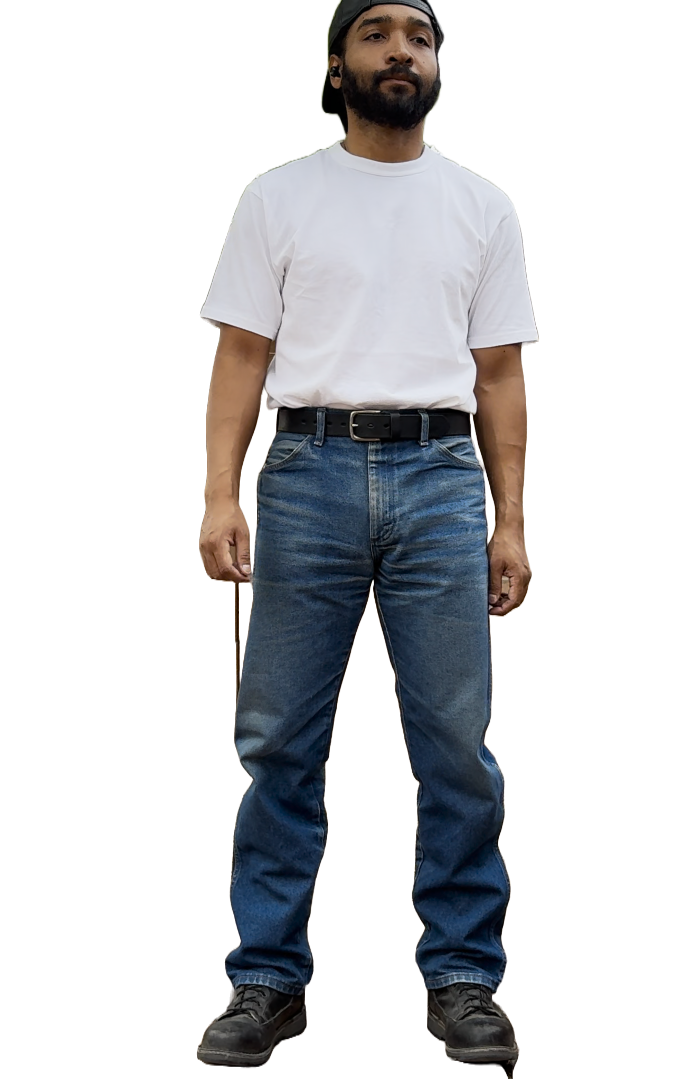
Before wash: Whitesville Size XL; I am typically US Medium or Large, 40-41" chest (~104 cm)
What is "7 oz"?
This is the weight of the Whitesville tee per square yard while raw and unwashed, which translates to about 237 gsm (grams per square meter).
After washing, the shirt can become up to approximately 7.4 oz, or 250 gsm.
The shirt falls squarely into the heavyweight category, but I would personally consider it a midweight; it doesn't feel super hefty, but it does feel well-made and sturdy compared to cheaper shirts around the same weight.
The second reason? The collar
One of the first things people notice with premium Japanese tees is just how substantial the collar feels.
If you've ever worn inexpensive or badly made t-shirts for long enough, you've probably encountered the dreaded bacon-neck, where the collar stretches and ripples, refusing to lay flat.
The Whitesville collar is thick, dense, and designed to retain its shape over years rather than just months. It's one of those details that sounds a little trivial until you actually hold the tee and see how it's constructed.
A sturdy collar dramatically changes the appearance of a plain t-shirt, upping its look without heading into peacocking territory. The thick collar frames the neck better, sits more cleanly underneath jackets and over-shirts, and makes your entire appearance appear more refined.
When you're wearing nothing but jeans and a white t-shirt, details like this start to matter a lot more.
The third reason? "The Bear" effect
Interestingly, premium white t-shirts have enjoyed something of a renaissance in recent years thanks in part to the FX series The Bear. I haven't seen it personally, but I can always appreciate a clean look.
Fans of the show quickly became obsessed with the simple white shirts worn by Jeremy Allen White's character, Carmy. Much of the attention focused on German manufacturer Merz b. Schwanen and their famous (actually) loopwheeled 215 t-shirt, which became notoriously difficult to find in stock after the show's success.
 Merz B. Schwanen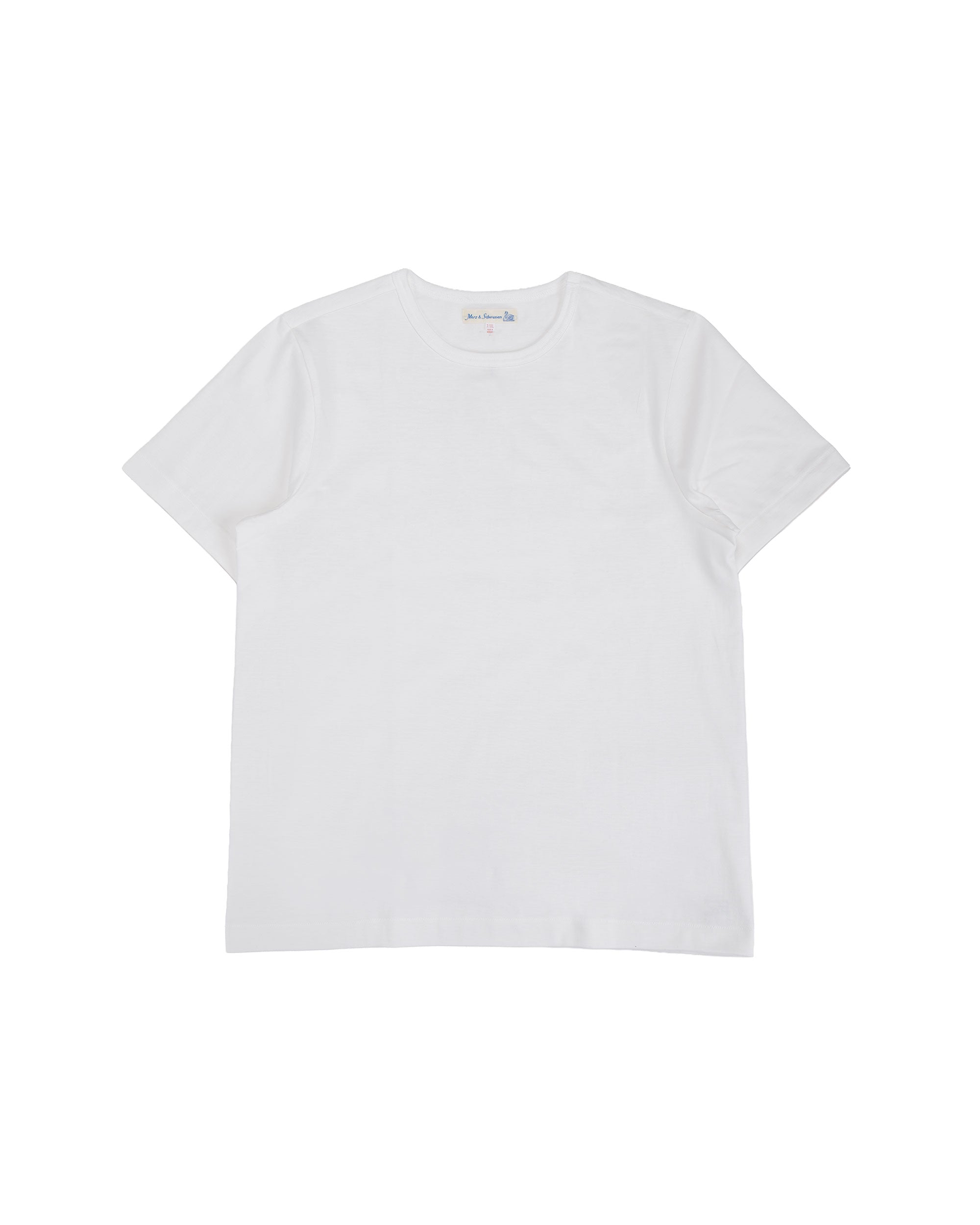
Ever popular and commonly sold out. More than double the price of 1 Whitesville tee (But it's actually loopwheeled). Earns commissions.
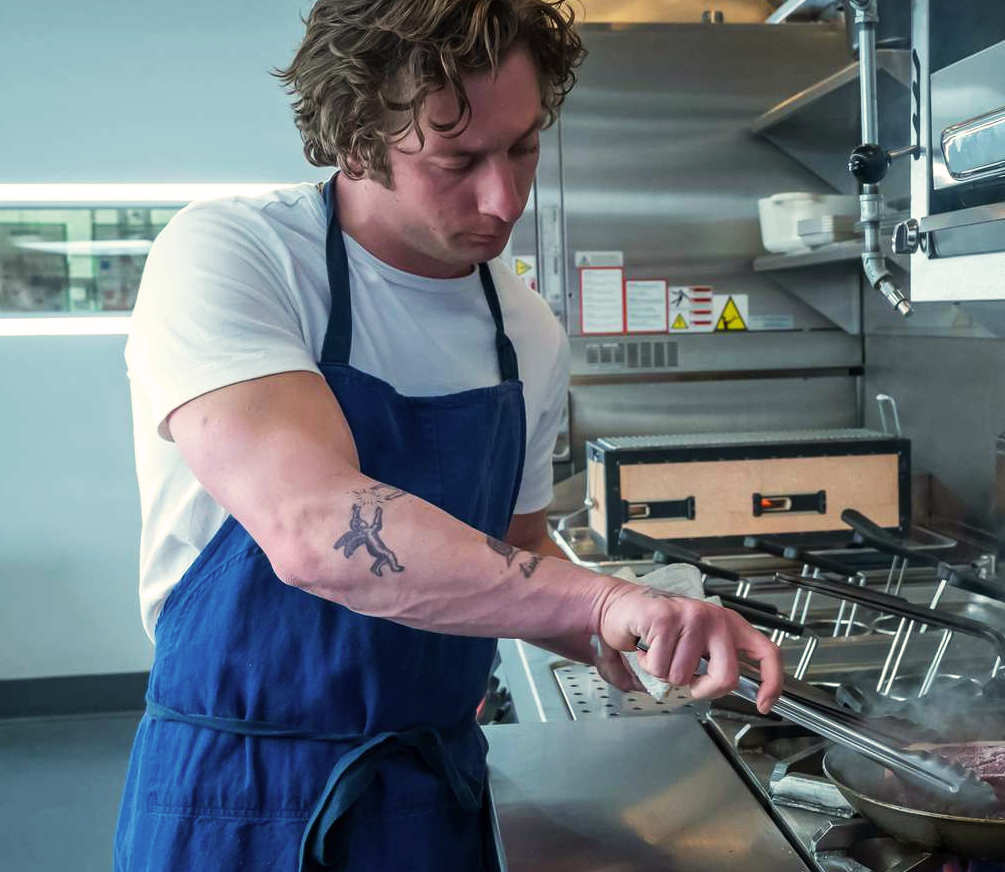
The comparison between Merz b. Schwanen and Whitesville is interesting because both brands pursue a similar philosophy: neither shirt relies on branding or trends. Instead, both emphasize old manufacturing techniques, premium materials, and timeless design.
The Merz t-shirt achieves this through traditional loopwheel knitting in Germany, while Whitesville is in Japan with vintage knitting machines that can somewhat simulate the low tension knitting of tsuri-ami-ki.
Whitesville technically does have loopwheel offerings, by the way (just not this 2-pack of tees).
 WHITESVILLE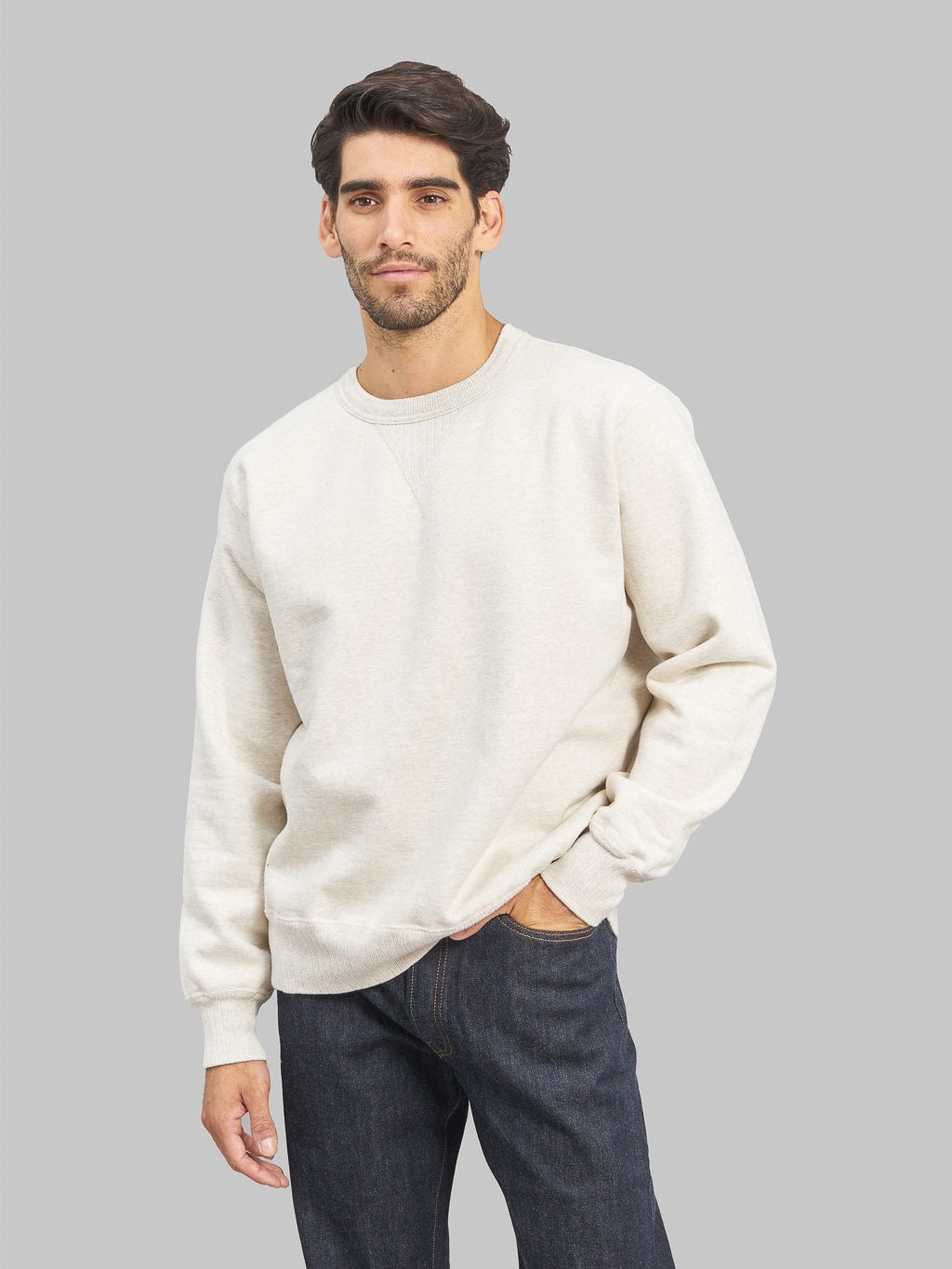
An oatmeal tsuri-ami sweatshirt by Whitesville. Earns commissions.
Are loopwheel/vintage circular knit t-shirts worth it?
Objectively speaking, you can purchase, like, ten inexpensive t-shirts for the price of a Whitesville 2-pack.
If your primary concern is simply covering your torso, premium tees make little financial sense. But clothing enthusiasts rarely evaluate garments purely on cost, or even value.
A good t-shirt is one of the most frequently worn items in almost any wardrobe. If you wear something dozens—or even hundreds—of times each year, investing in superior materials and construction starts to feel far more reasonable.
- The well-designed fit looks better
- The fabric feels better and ages better
- The construction lasts longer
- It won't twist over time like a modern (cheap) tubular knit
And perhaps most importantly: you simply enjoy wearing it more because it makes you feel premium yourself when you wear the shirt.
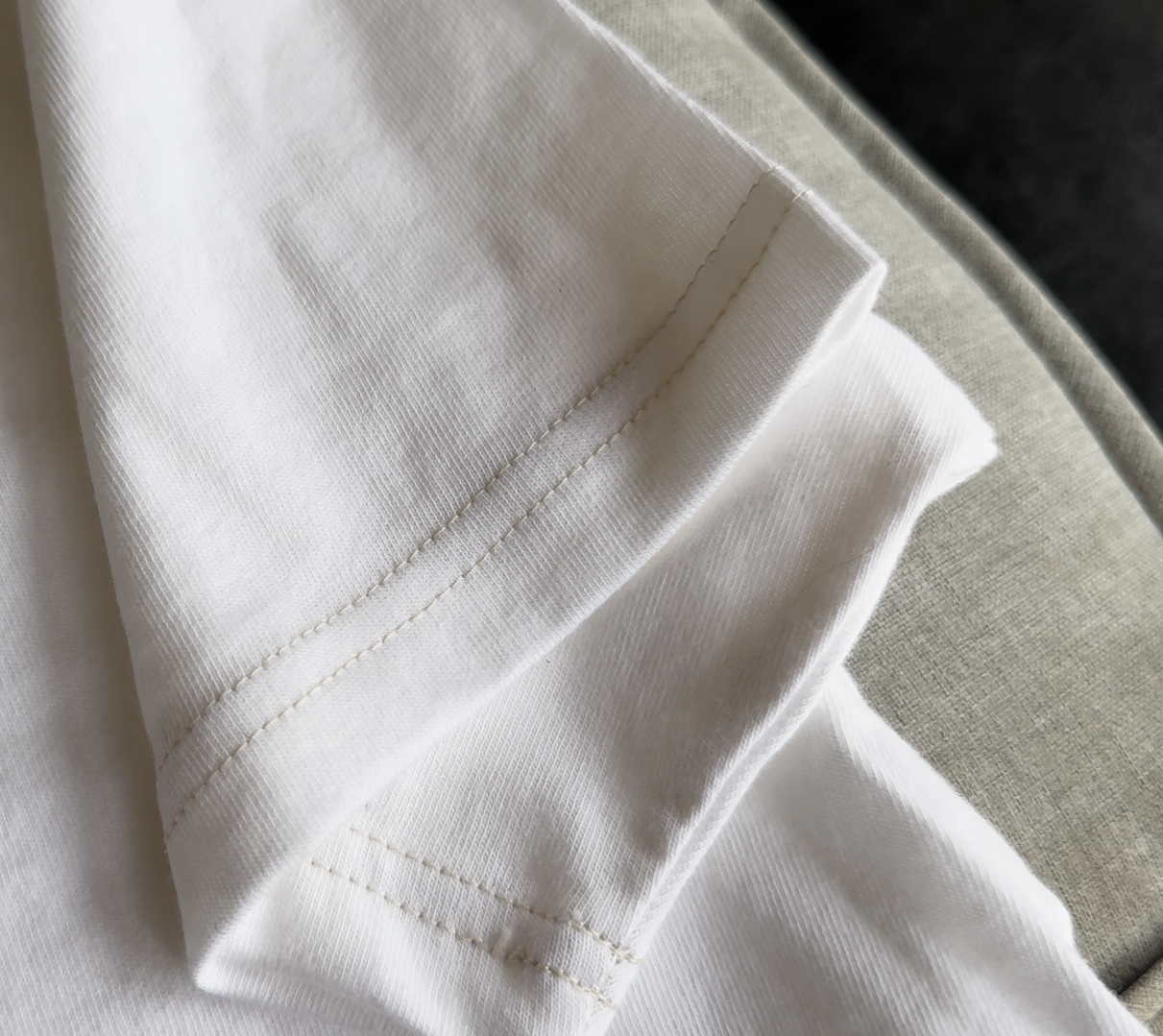
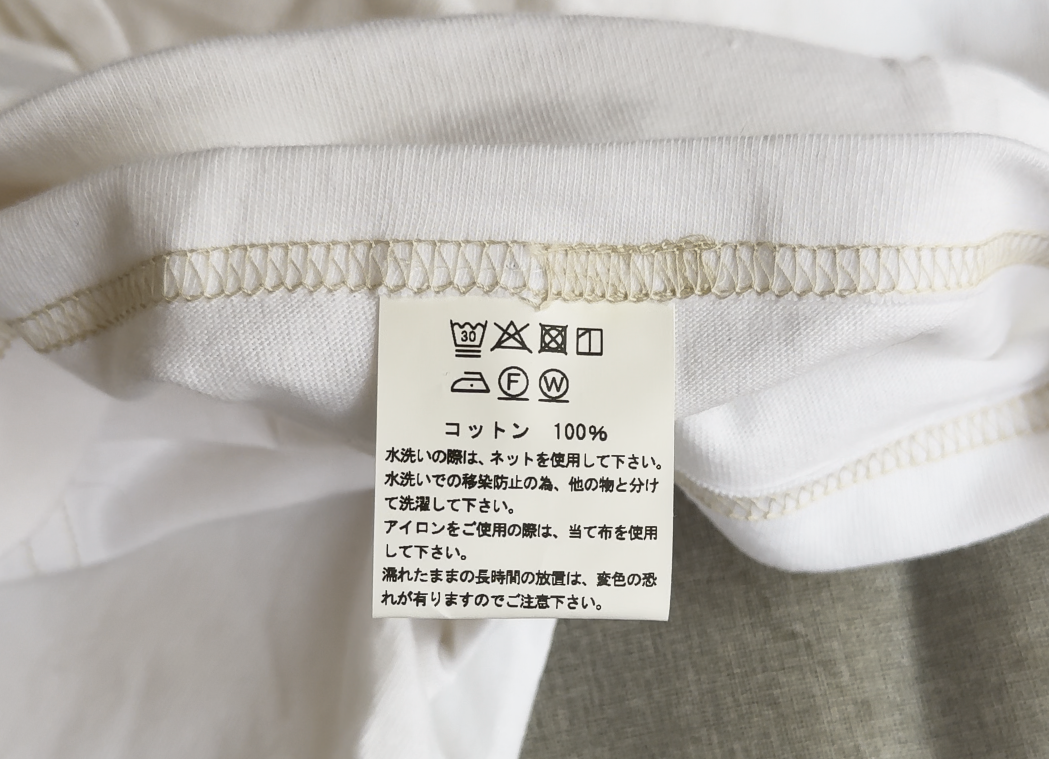
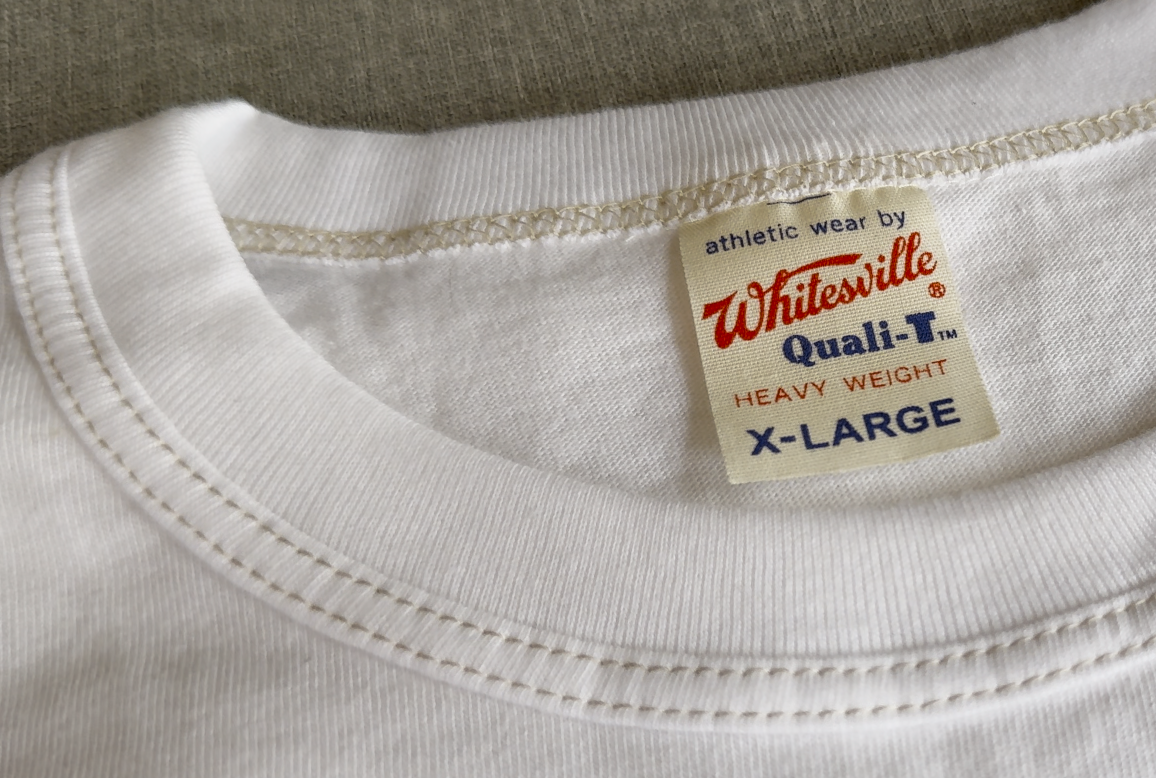
Contrasting, double-needle stitching and care label: Whitesville Heavyweight Quali-T
Once you become accustomed to high-quality basics, it's surprisingly difficult to go back to cheaper stuff. It's not about hype, although you could argue TV shows and influencers can generate some.
It's about the heritage, prestige, and thoughtfulness that goes into every t-shirt. Even in a 2-pack.
Measurements
This will be an example of Japanese XL sized shirts, which equate to a U.S. Medium or Large after shrinkage.
I have a 40–41" chest (102–104 cm) and usually wear American sizes M or L.
| Measurement (Size XL) | Pre-Wash (New) | Warm Wash + High Heat Dry (Shirt 1) | Cold Wash + Line Dry (Shirt 2) | Shrinkage (Warm + Dryer) |
|---|---|---|---|---|
| Chest Width (Pit-to-pit) | 21.25" / 54.0 cm | 20.5" / 52.1 cm | 20.7" / 52.6 cm | 0.75" (1.9 cm) |
| Body Length | 27.5" / 69.9 cm | 26.5" / 67.3 cm | 27.15 / 69 cm | 1.0" (2.5 cm) |
| Shoulder Width | 19.5" / 49.5 cm | 18.6" / 47.2 cm | 19" / 48.2 | 0.9" (2.3 cm) |
| Sleeve Length | 9.0" / 22.9 cm | 8.5" / 21.6 cm | 8.75" / 22.2 cm | 0.5" (1.3 cm) |
| Sleeve Opening | (Forgot) | 6.5" / 16.5 cm | 6.6" / 16.8 cm |
Note: Measurements were taken (new) before washing, (1) after a warm machine wash followed by a high-heat tumble dry, and (2) after a cold machine wash with line drying. Whitesville recommends cold washing and line drying to minimize shrinkage and preserve the shirt's original fit.
The proportions will create a boxier look the more the shirt shrinks, whereas the Merz B. Shwanen t-shirt will have a longer European-style length. If you missed it earlier, Carmy's shirt in The Bear was cropped to be shorter on his torso (or see the 2M15C which was made in response to his cropped shirt).
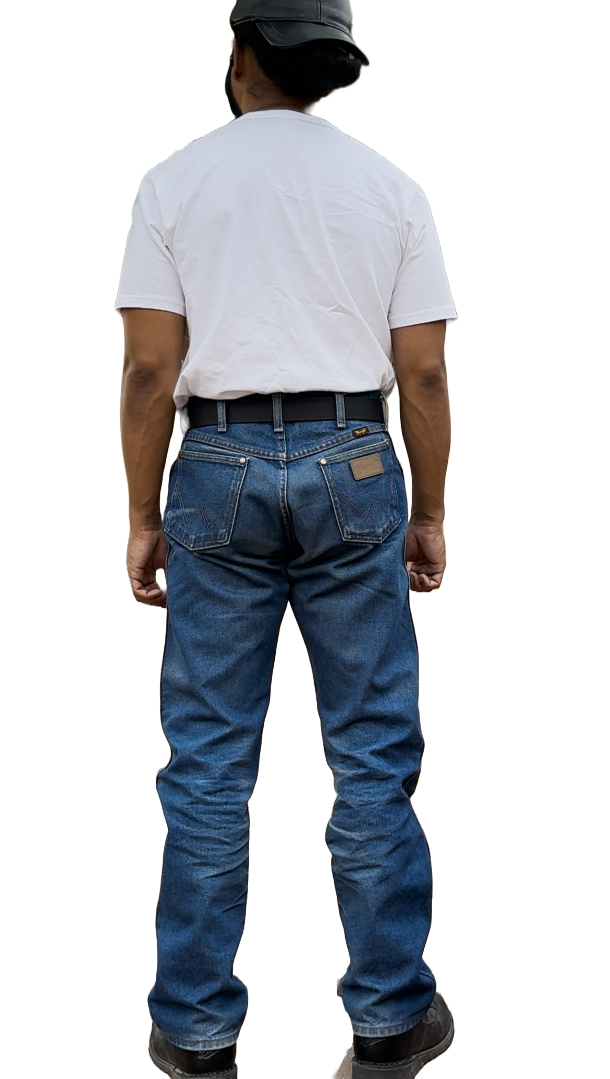
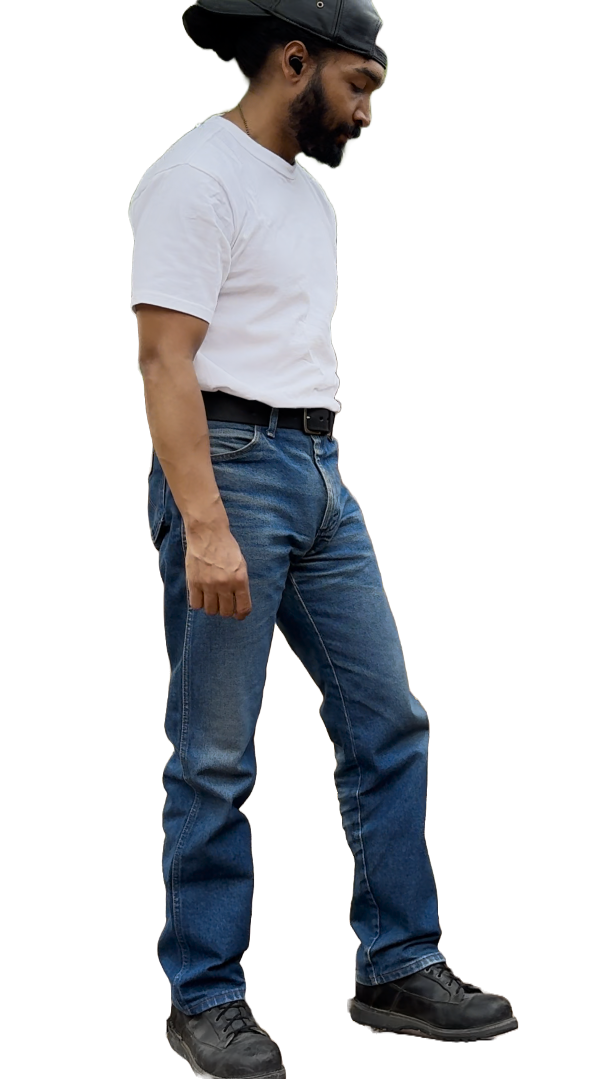
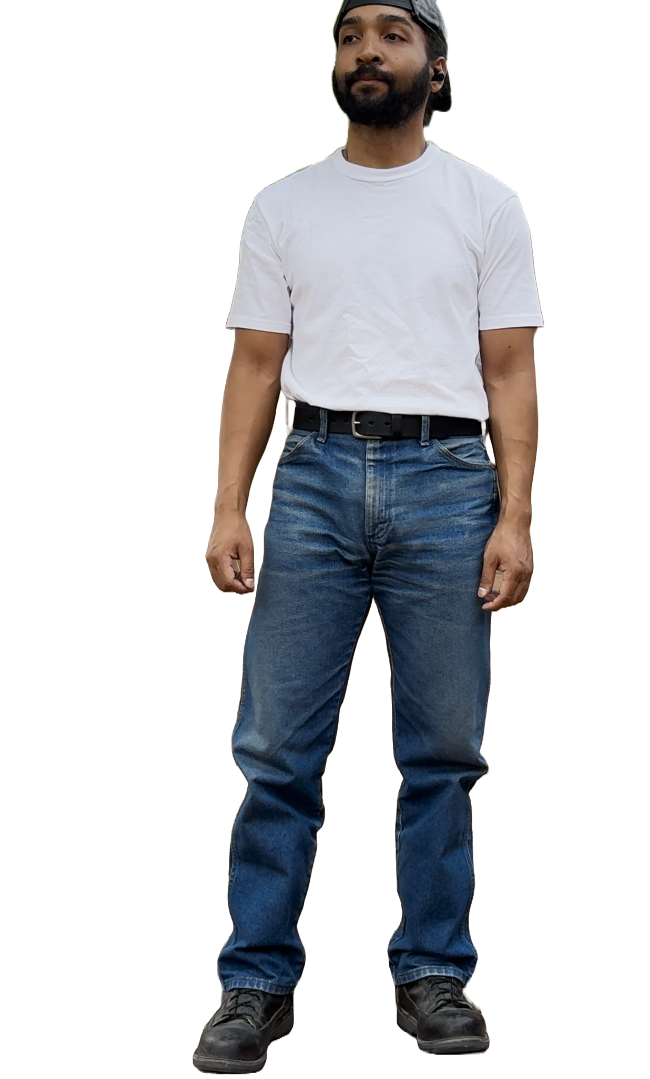
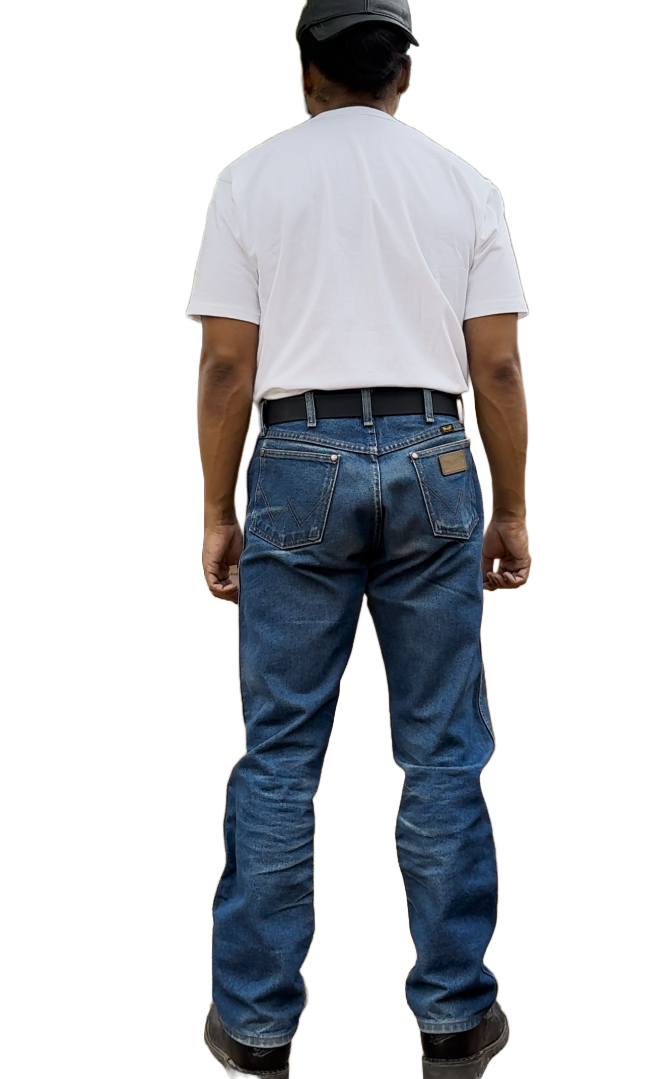
After wash: how Whitesville look after shrinking (Shirt 1; warm water, high heat). Wearing tucked into Wrangler 13MWZ jeans.
Whitesville's care tag says to wash cold and line-dry, and that's what I'd recommend people do. Personally? I like to toss my tees into a washer and dryer, hence why I sized up instead of hoping an accidental dryer-run doesn't happen at some point.
This T-shirt is finished with an unwashed (non-wash) process, meaning it has not undergone any washing treatments during manufacturing.
In its new, unwashed state, the fabric has a slightly coarser weave, but after washing, allowing it to air dry, the cotton fibers tighten, increasing the fabric density and slightly increasing the thickness as the weave becomes tighter.
As a result, the T-shirt is expected to shrink slightly in the vertical direction (length) by approximately 2%-3% before washing.
The shrinkage in the horizontal direction (chest width) is minimal Moreover, as you wear and wash it repeatedly, the fabric will further soften and develop the unique texture characteristic of cotton The fabric combines a firm fit with a supple softness. — Whitesville (ホワイツビ) product page on Amazon.co.jp
In terms of personal sizing, I like the Japan XL for me (41" chest, 31" waist), but if I wanted to wear them as lowkey undershirts, I would choose Large. I'll still be rocking these XLs under other shirts and jackets, but they'll be more noticeable in general.
Buy Whitesville tees
Affiliate links present; I earn commissions for sales.
 Whitesville
 Whitesville
 Whitesville
 Whitesville
Watch the YouTube video
Watch my video on it! It's unscripted, so I refer to the t-shirts as a loopwheeled
Final thoughts
For years, I viewed t-shirts as the least important item in my wardrobe to spend money on. Today, I think they might be leaning toward being one of the most important.
These Whitesville tees won't magically transform your wardrobe — they're still just plain t-shirts. And if you're trying to add flair to your style, I don't think a t-shirt is what you want to buy right now.
But in an era where many basics are designed to be inexpensive and disposable, Whitesville offers something refreshingly different: a garment built with care, premium materials, and a philosophy centered around longevity.
After all, if you're wearing a t-shirt several times each week, either on its own or underneath something else, it probably deserves just as much attention as your boots, jeans, or jacket. Everyone sees the tee, they might as well see one that's...
Quali-T
It's in the details. They matter, and we see 'em.